Federalizing D.C.: What the Law Enforcement Takeover Means For Us All
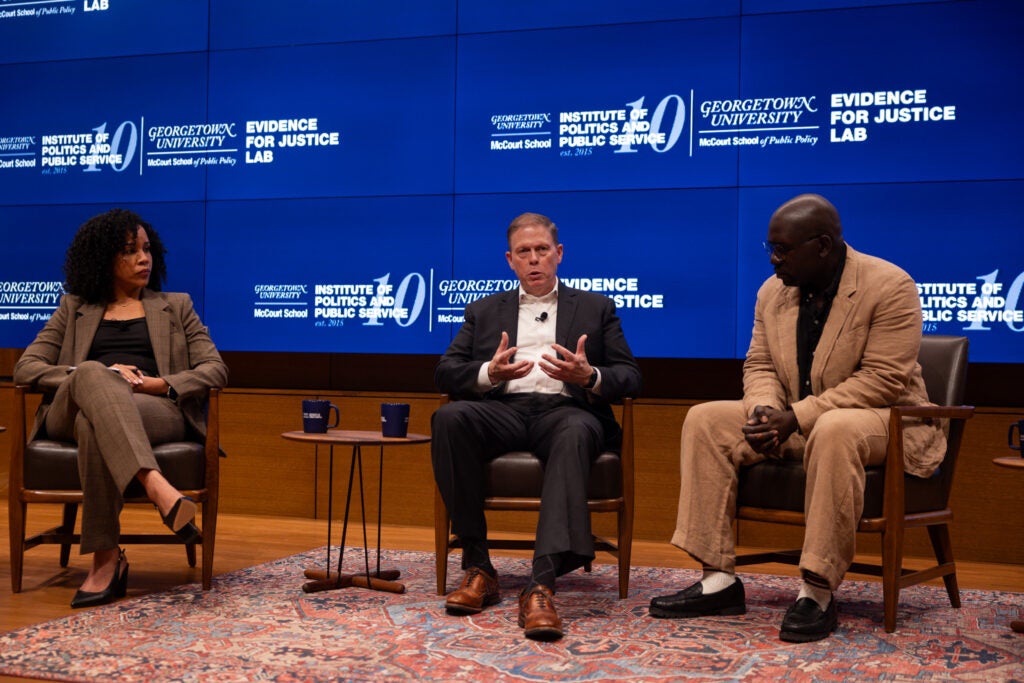
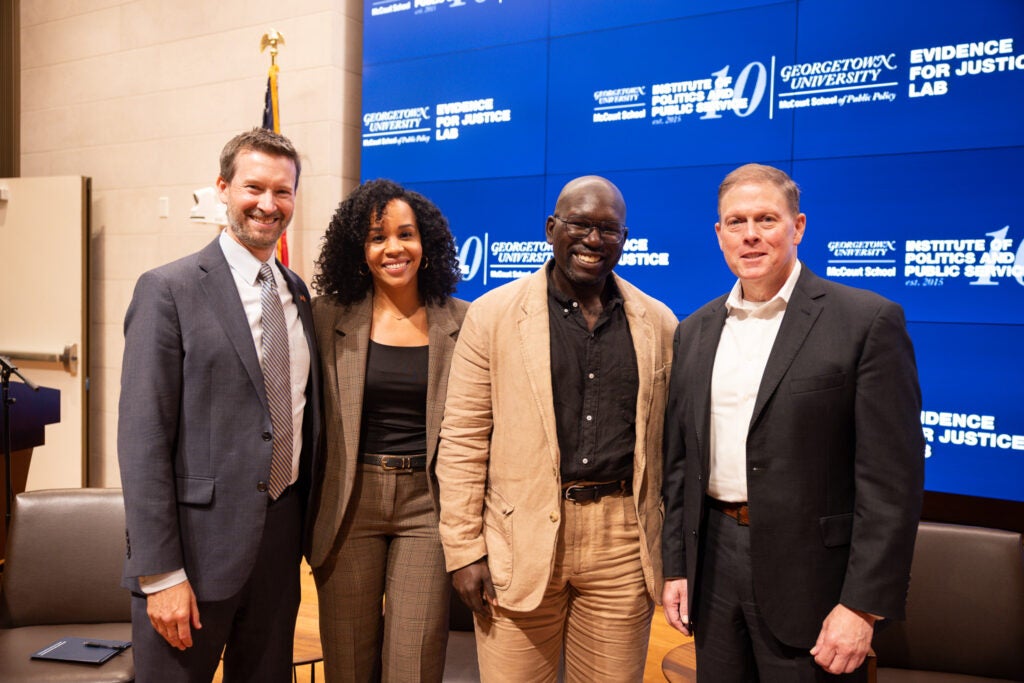
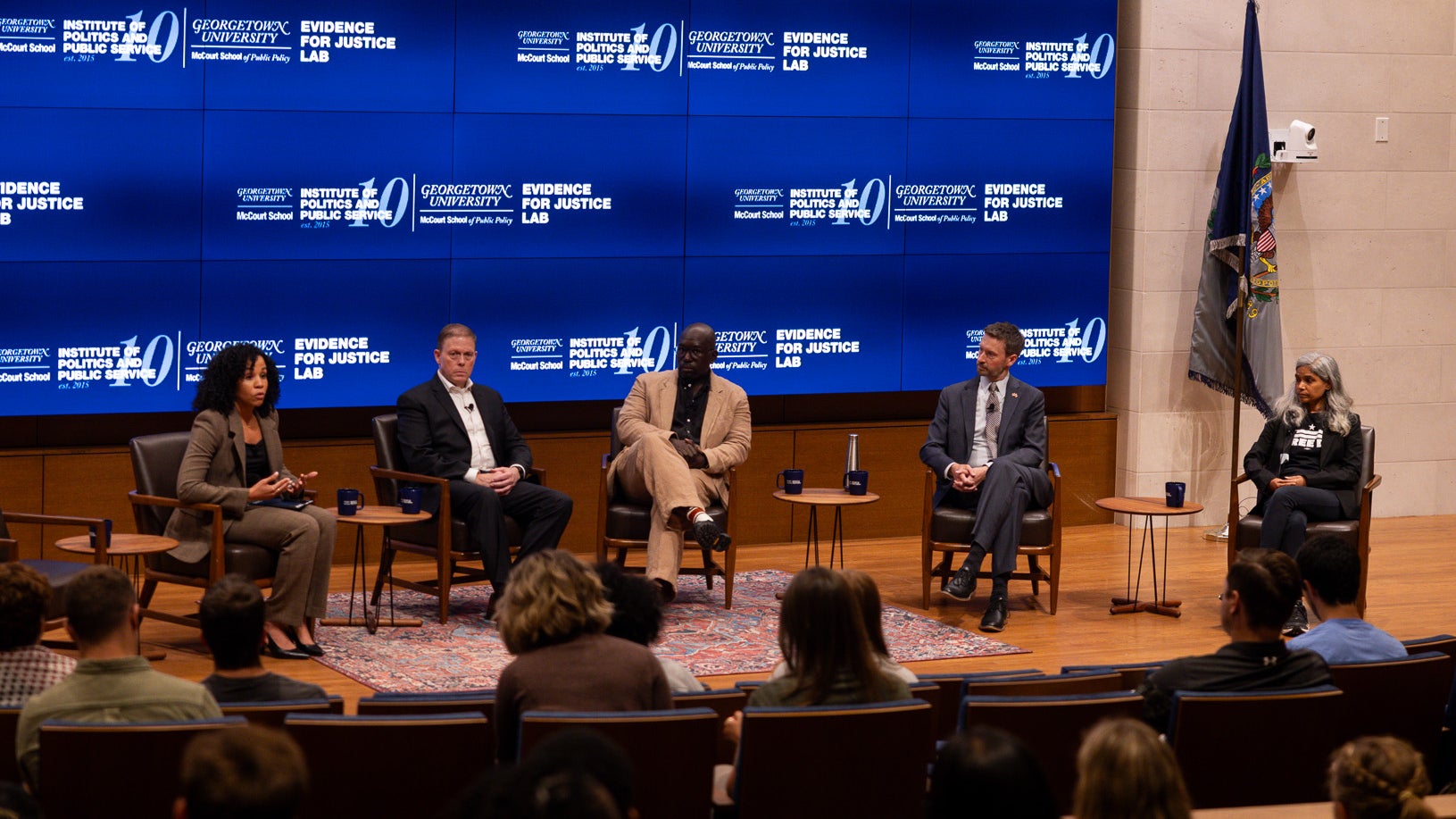
On September 10, Georgetown University’s Institute of Politics and Public Service and the McCourt School of Public Policy’s Evidence for Justice Lab, hosted a timely panel discussion on the Trump Administration’s federalization of D.C law enforcement. The event, moderated by Dr. Andrea M. Headley, Faculty Director of the Evidence for Justice Lab, featured D.C. Ward 6 Councilmember Charles Allen, New York Times Opinion Columnist and Fall 2025 GU Politics Fellow Jamelle Bouie, Free D.C. Executive Director Keya Chatterjee, and former U.S. Capitol Police Chief Steven Sund.
In the pursuit of dialogue that bridges justice and public safety, the Evidence for Justice Lab alongside with the Institute of Politics and Public Service brought together diverse voices just thirty days after President Donald Trump declared a federal emergency in Washington, D.C. on August 11, 2025. This was an unprecedented move that initiated a federal takeover of the Metropolitan Police Department (MPD), launched a federal investigation into MPD crime statistics, and resulted in sweeping enforcement actions. These actions caused the clearance of more than 50 homeless encampments, the confiscation of over 200 firearms, and an executive order from Mayor Muriel Bowser requiring local agencies to cooperate with federal authorities.
The declaration has ignited widespread public backlash, with critics characterizing the federal presence as a “military occupation.” The D.C. Attorney General has since filed suit against the administration, alleging an illegal deployment of federal forces. As members of Congress now discuss extending similar emergency declarations to cities such as Chicago and Baltimore, the panel examined not only the implications for the District, but the precedent such actions could set nationwide.
With his perspective and background in law enforcement and public safety, former U.S. Capitol Police Chief Steven Sund notes how in D.C. history, coordination with the FBI and other federal agencies has long been part of public safety efforts. Sund recounted how in conversations with law enforcement, they support being coordinated as a team with the federal government in interest of public safety. Given that MPD is currently understaffed by roughly 800 officers, Sund described federal involvement as a potential “force multiplier.” However, he cautioned that the central question moving forward is not whether coordination occurs, but “how do we carry this forward in a proper fashion?”
Councilmember Charles Allen, who chairs the D.C. Council’s Committee on Public Safety, strongly disagreed with the premise of the federal takeover. He argued that the move was less about crime prevention and more about “power and control.” Allen warned against the politicization of public safety, in which fear is leveraged to justify federal intervention despite declining violent crime rates and ongoing cooperation between local agencies, the Mayor’s office, and the D.C. Council. He emphasized that invoking a state of emergency “isn’t backed up by the facts.”
Allen also highlighted the contrast between local and federal law enforcement accountability. MPD officers are required to display identifying information and are prohibited from masking their faces, while many federal agents operate anonymously. He argued that these agents are trained to combat true security threats, not community policing, and that such tactics are ill-suited for the District’s current conditions and public need.
Free D.C. Executive Director Keya Chatterjee echoed these concerns, characterizing the federalization of D.C. law enforcement as an “authoritarian power grab” imposed without the consent of District residents or leadership. She raised alarms over federal agents’ use of stop-and-frisk tactics and alleged Fourth Amendment violations, disproportionately affecting men of color, young people, immigrants, and unhoused residents. Chatterjee described warrantless arrests conducted by unmarked and masked agents as “kidnapping,” noting reports of individuals being detained and transported outside the District. She emphasized that public resistance and backlash to these actions continues to grow.
Jamelle Bouie situated the events within a broader democratic framework, warning that the administration’s actions contribute to the “image and pageantry of authoritarianism.” He reminded the audience that the United States is a democratic republic grounded in self-governance and federalism, arguing that deployments of the National Guard and federal forces should be viewed “very skeptically, and even with hostility.”
As the nation watches closely, Washington once again becomes a testing ground for the balance between order and freedom. The panel made clear that evidence, not fear, must guide public policy. In bridging dialogue between data and lived experience, Georgetown’s Institute of Politics and Public Service and the Evidence for Justice Lab reaffirmed a core democratic principle: public safety is strongest when it is local, transparent, accountable, and rooted in the consent of the governed.
Watch the full recording of the event here: https://www.youtube.com/watch?v=8uhr77Bh2Kc&t=2680s