Beyond the Black Box: AI and the Intersection of Race and Prejudice
By Teresa Fang, Policy and Communications Assistant (Spring 2026)
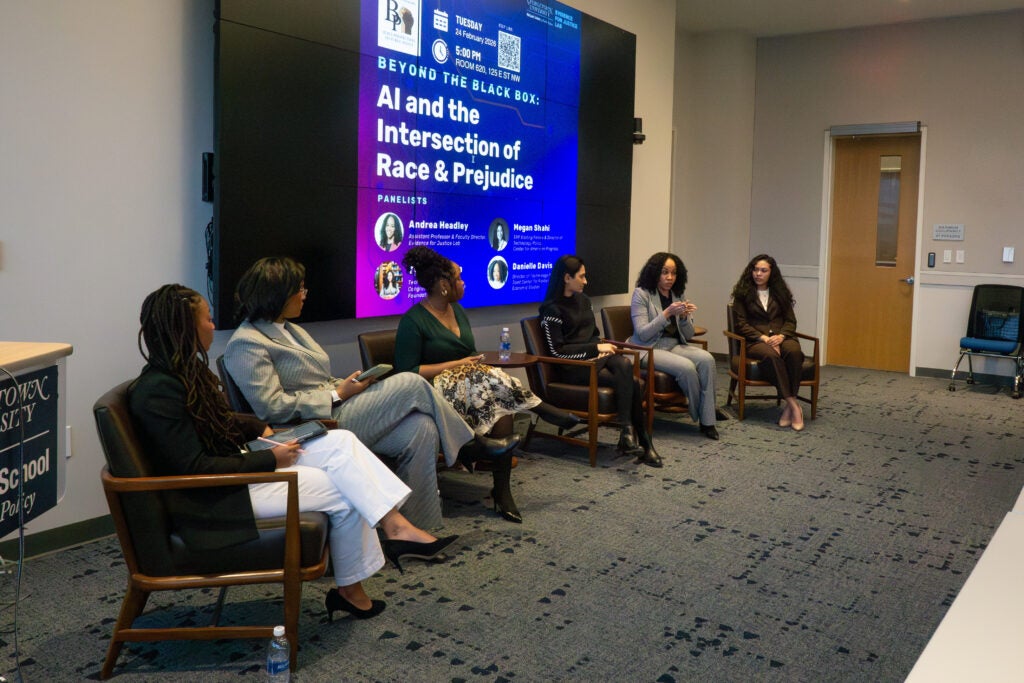
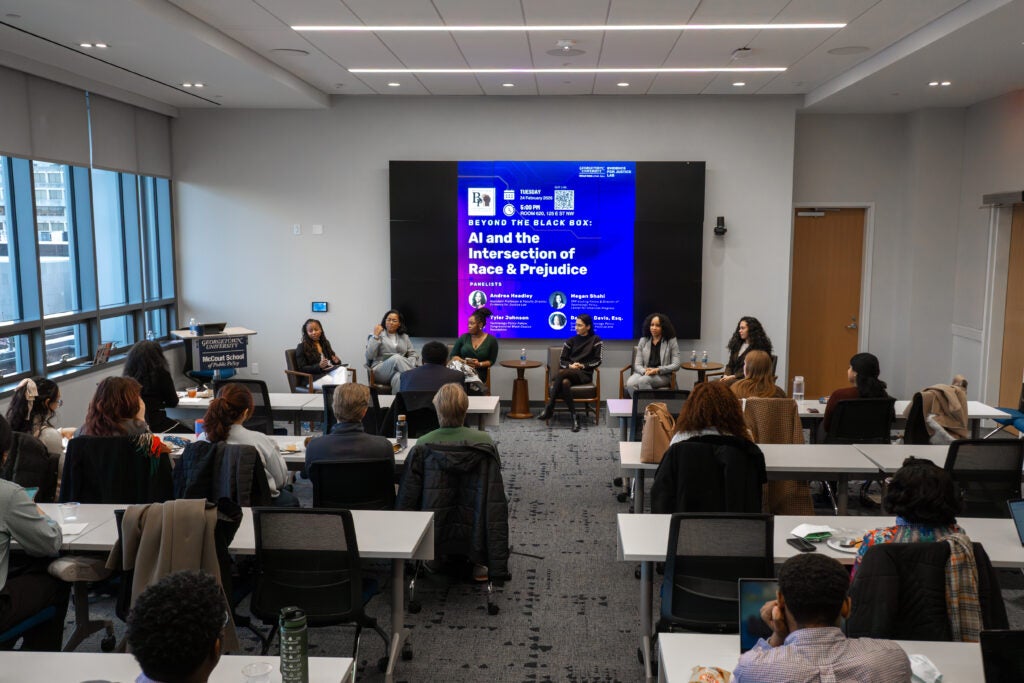
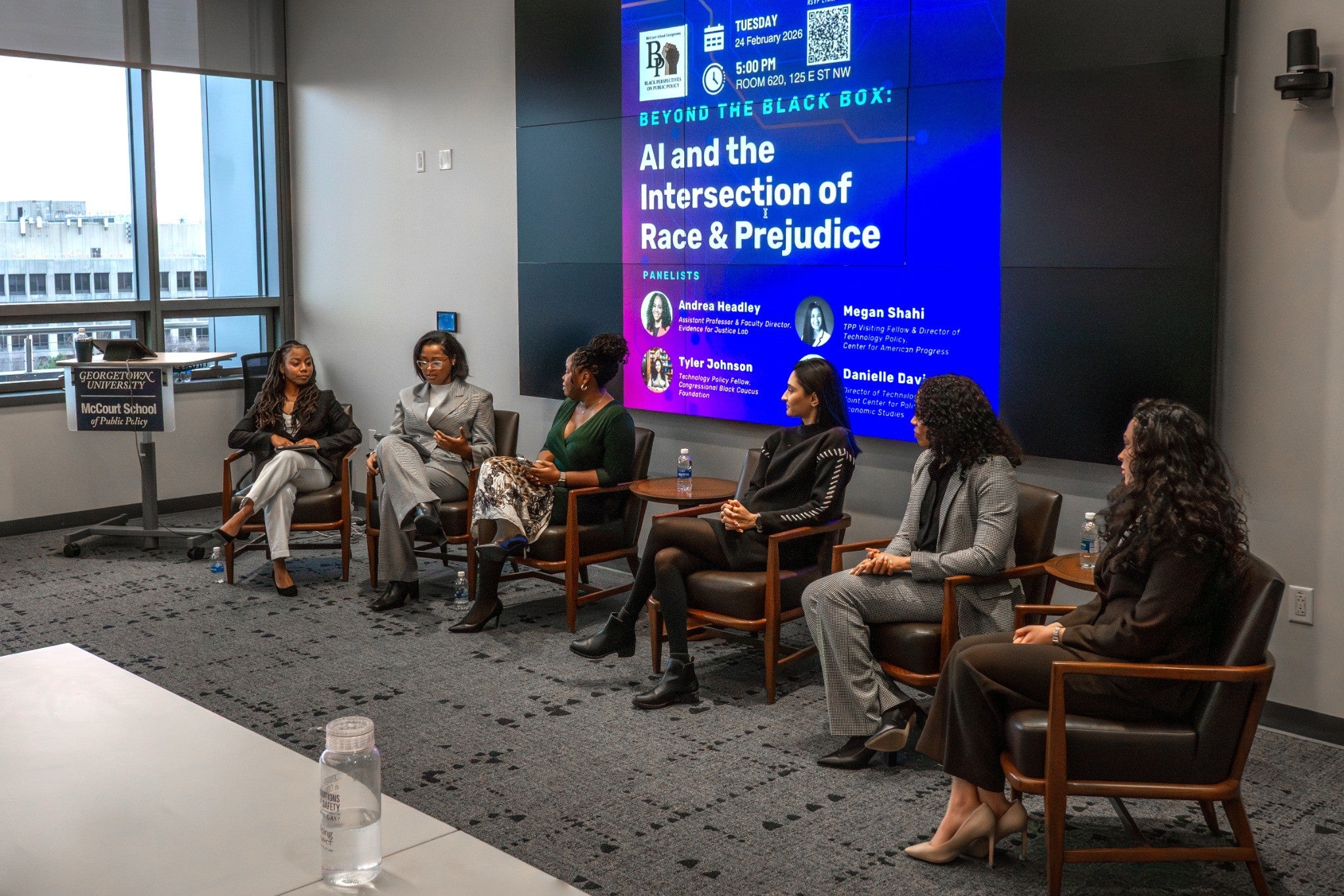
On Tuesday, February 24, 2026, in celebration of the 100th anniversary of Black History Month, a critical conversation titled Beyond the Black Box: AI and the Intersection of Race and Prejudice was hosted by Black Perspectives on Public Policy (BPoPP). The event brought together diverse voices, including past and present members of the Evidence for Justice Lab, who played a key role in organizing and contributing to the discussion. Panelists examined and challenged the myth of technological neutrality, while exploring how the rapid development of digital technologies continues to shape and impact Black communities.
Drawing on real-world examples and research of the tech policy scholars on the panel, student moderators Joya Wheatfall-Melvin (DSPP ’26) and Daija Yisrael (MIDP ‘26), current team members at E4J, guided a discussion on the ethical use of AI through a policy lens that considers the accountability of the institutions that most shape our lives. The esteemed panel featured leading voices in technology policy today: Andrea M. Headley, Georgetown McCourt Associate Professor and Faculty Director of the Evidence for Justice Lab, Danielle Adrianna (Davis) Canty, Esq., Director of Technology Policy at the Joint Center for Political and Economic Studies, Megan Shahi, Visiting Fellow at McCourt Tech and Public Policy and the Director of Technology Policy for the Center for American Progress, and Tyler Johnson (MPP ‘25), a Technology Policy Fellow at the Congressional Black Caucus Foundation and former E4J member.
The panel discussion centered on the reality that AI systems are not impartial, but rather tend to mirror and amplify existing societal biases. The panelists delved into the regulation of AI-powered surveillance, ranging from predictive policing to social media monitoring, and the influential role these private vendors play in shaping public infrastructure.
Megan Shahi underscored that while AI has the capacity to “make good things better,” it can just as easily “make bad things worse.” She emphasized that as these technologies are increasingly deployed in high-stakes service areas, it is essential to remain vigilant about both their potential benefits and the risks they carry.
Danielle Adrianna (Davis) Canty, Esq. added a sobering perspective on the data economy, observing that “you’re not just using these tools, these tools are using you.” She highlighted the significant tradeoffs in information exchange when using AI and how these very systems can subtly influence human behavior and impede on individual privacy.
Representing the Evidence for Justice Lab, Dr. Headley shared how E4J is actively working to bring transparency to these “black box” systems. She highlighted two ongoing projects at E4J designed to promote equity: the Justice and AI Tracker, which monitors the deployment of AI technologies, and the AI Perceptions Study, which researches how different communities perceive and are affected by AI-enabled decision-making in the justice system.
The conversation also moved towards the future: Who gets left behind in an AI-driven world? Tyler Johnson noted that AI regulation has moved to the forefront of Congressional priorities. She emphasized that AI’s impact is “cascading,” affecting everything from energy to environmental policy, and stressed the importance of understanding how these effects disproportionately impact different communities.
Building a fairer digital future requires policymakers and leaders to challenge norms and create more channels of participation to bring community voices to the forefront. As Dr. Headley noted, it was especially meaningful to see both current and former members of the Evidence for Justice Lab stepping into the role of thought leaders – actively shaping conversations at the intersection of AI, policy, and equity.
Ultimately, the discussion reinforced a clear and timely message: as technology continues to reshape society, building a fair digital future requires more than innovation alone. It demands intentional efforts to equip all communities with the tools, knowledge, and protections needed to both benefit from AI and guard against its risks.