Confronting Gun Violence with Lived Experience: Inside the Launch of McCourt’s Evidence for Justice Lab
By Teresa Fang, Policy and Communications Assistant (Fall 2026)
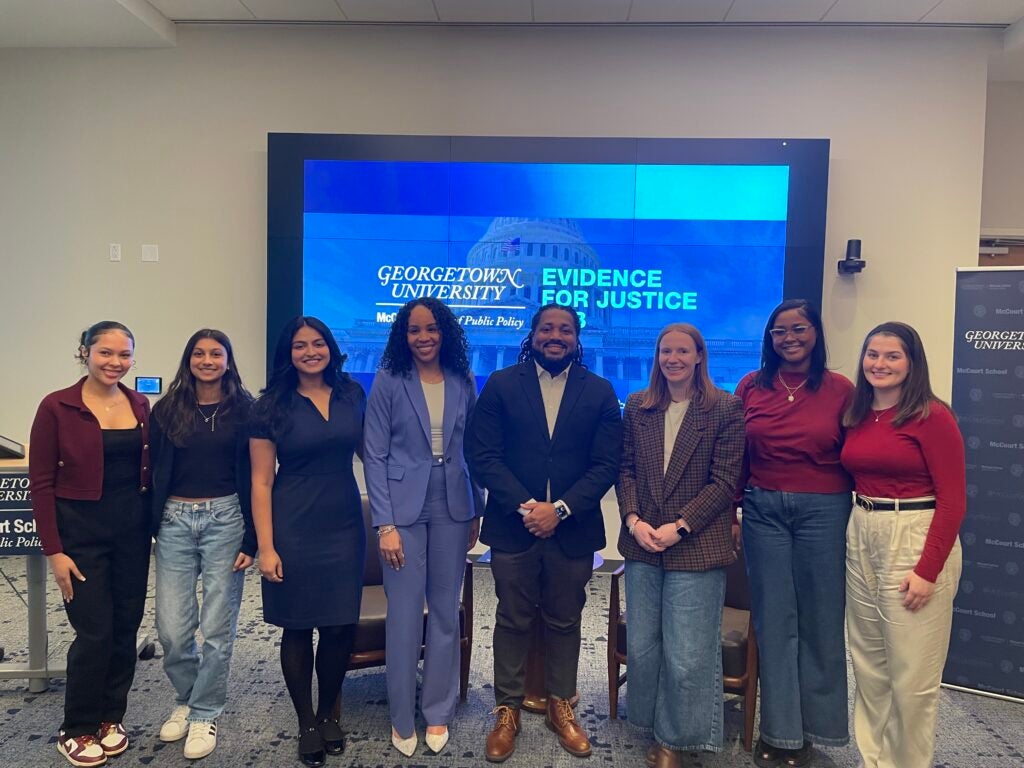
On February 27, 2025, the McCourt School of Public Policy officially launched the Evidence for Justice Lab, directed by Dr. Andrea Headley. The launch embodied the lab’s core mission to create a platform where people with lived experience and those working on critical criminal justice issues can come together for honest, solutions-oriented conversation.
From Survival to Advocacy
The launch featured Gregory Jackson Jr., former Deputy Director of the White House Office of Gun Violence Prevention. Jackson opened by recounting his own experience as a survivor of gun violence, an experience that exposed the profound failures victims can face even in moments of crisis.
“I was interrogated three times before I received medical attention,” Jackson shared, recalling the weight of having to “defend my innocence before anyone wanted to save my life.”
That moment, and the long recovery that followed, transformed his pain into purpose and propelled him into a life of advocacy.
Breaking Barriers in the White House and Beyond
Reflecting on his tenure in the Biden-Harris administration, Jackson detailed the early hurdles of establishing the White House Office of Gun Violence Prevention. He recalled a pivotal cabinet meeting where Vice President Kamala Harris demanded three concrete, immediate actions, a challenge that catalyzed initiatives like the Department of Education’s gun storage program.
Underscoring the scale of the crisis, Jackson noted that one in five people in the United States are impacted by gun violence, challenging the notion that it is a niche issue. He was quick to point out that policy on paper is only half the battle. Meaningful reform not only requires sound policy, but better communication and “more messengers” who can speak credibly to different communities. He argued for a robust emergency response system specifically for survivors, noting that the political friction between local and federal governments often stalls the very aid these communities need.
Beyond legislation, Jackson also challenged common assumptions about public safety, stating pointedly, “The bogeyman is not a white van—it’s the nightstand,” highlighting the dangers of unsecured firearms in homes. He identified interpersonal violence as the largest driver of gun violence and called attention to youth mental health as a critical, yet too often overlooked, component of prevention.
Reframing the Gun Violence Epidemic
Drawing a comparison to the COVID-19 pandemic, Jackson asked why public health systems could track a virus in real time but lack the infrastructure to track gun violence. His answer was clear: gun violence must be treated as the public health crisis that it is. He concluded by reminding the audience that many who go on to harm others were once victims themselves, investing in victim services that are not only compassionate, but serve as a primary tool of prevention.
For Jackson, gun violence prevention isn’t a policy exercise; it’s an intimate, lived reality. Even while fighting for his life on a hospital bed, he was treated as a suspect before a victim. This dehumanizing encounter fueled a lifelong resolve to dismantle the biases that plague Black and brown communities. His presence at the launch served as a powerful reminder that for the Evidence for Justice Lab, “lived experience” isn’t just a buzzword, but rather the very foundation upon which all meaningful reform and research must be built.
The launch of the Evidence for Justice Lab marked an exciting beginning, setting the tone for a future where data, policy, and human experience come together to break cycles of harm and advance justice.